


On a calm evening, I (Ruby) met Ruby at the restaurant inside of the Standard in London. We had a wonderful conversation over the course of many small dishes. We later met online for the opening of her new show Event-0: Manual Override.
RJT: For our readers, first of all, please introduce yourself.
Ruby Chen: My name is Ruby Chen. I recently graduated from the master’s program at the Royal College of Art, but my undergraduate academic background is in economics. A lot of the research behind my practice comes from a sociopolitical standpoint.
With this exhibition in particular, the research came from observations I’ve made about the world and an attempt to formulate a visual understanding of how we, as humans, currently exist in a society where technology is increasingly overtaking much of our lives.
Are there any optimistic ways of viewing it, rather than the very pessimistic angles we’ve been hearing over and over, which generate nihilism? Is there a way of combating that and seeing it in a more positive light?
Through my research for the show, I believe I’ve reached a more positive opinion of the future. Whether that future actually happens is yet to be determined, of course.
RJT: I feel like there’s a tension between the positive vision of the future and the severity of your visual language, concrete, metal tubes, machinery. Can you unpack that for me please?
Ruby Chen: In terms of how I view technology, it’s very difficult for it not to feel oppressive, because so much of my life is heavily dependent on it.
More broadly, the corporations or bureaucratic powers behind technology, especially technology used for militaristic purposes, have such huge impacts on entire populations that it’s difficult for me not to view it as oppressive and dark.
A lot of my research initially goes in that direction: technology becomes an environment, an ecology that swallows the human beings existing within it. Instead of technology being a human tool, with us at the center as users.
The optimism comes from the idea of entropy: how chaos will always take over order, and how human beings, despite being swallowed by this ecology, can resurface almost as an invasive species or a source of contamination.
With technology and machinery, so much is about total optimization, predictability, and sterilization. But when human beings become part of that, our primal drives and desires are conflicting factors. They’re like viruses in the machine system, corrupting the predictability and total optimization the machine wishes to create.
Even if technology is an all-consuming ecosystem that engulfs us, I believe there are ways for us to overcome it simply by being imperfect, irrational, and easily affected by emotion. These are elements that can help us overcome this oppressive ecosystem.
RJT: I love that so much. I think I told you the same thing over dinner: it’s one of the most radical but also optimistic insights.
It reminds me of what Heidegger would call “slippage.” In so many contemporary writing, even with Ted Kaczynski, the Unabomber, there’s this sense of an inability to control technology. For a lot of people, especially this week, with all the AI conversations about the end of the world and a 10% chance of human extinction, as we’ve heard on the news, there’s a feeling that we cannot control our destiny as human beings.
Yet I think one of the wonderful insights in your work is that this philosophy, this belief that we will disappear, only exists in a world of models and perfect calculation. In fact, our impurity, opacity, and illegibility as humans make us radically hard to drive to extinction, because we’re not perfect. We kind of suck, in a way, which makes it very difficult to be a target.
The human as a virus in the machine ecosystem is such a beautiful and radical idea.
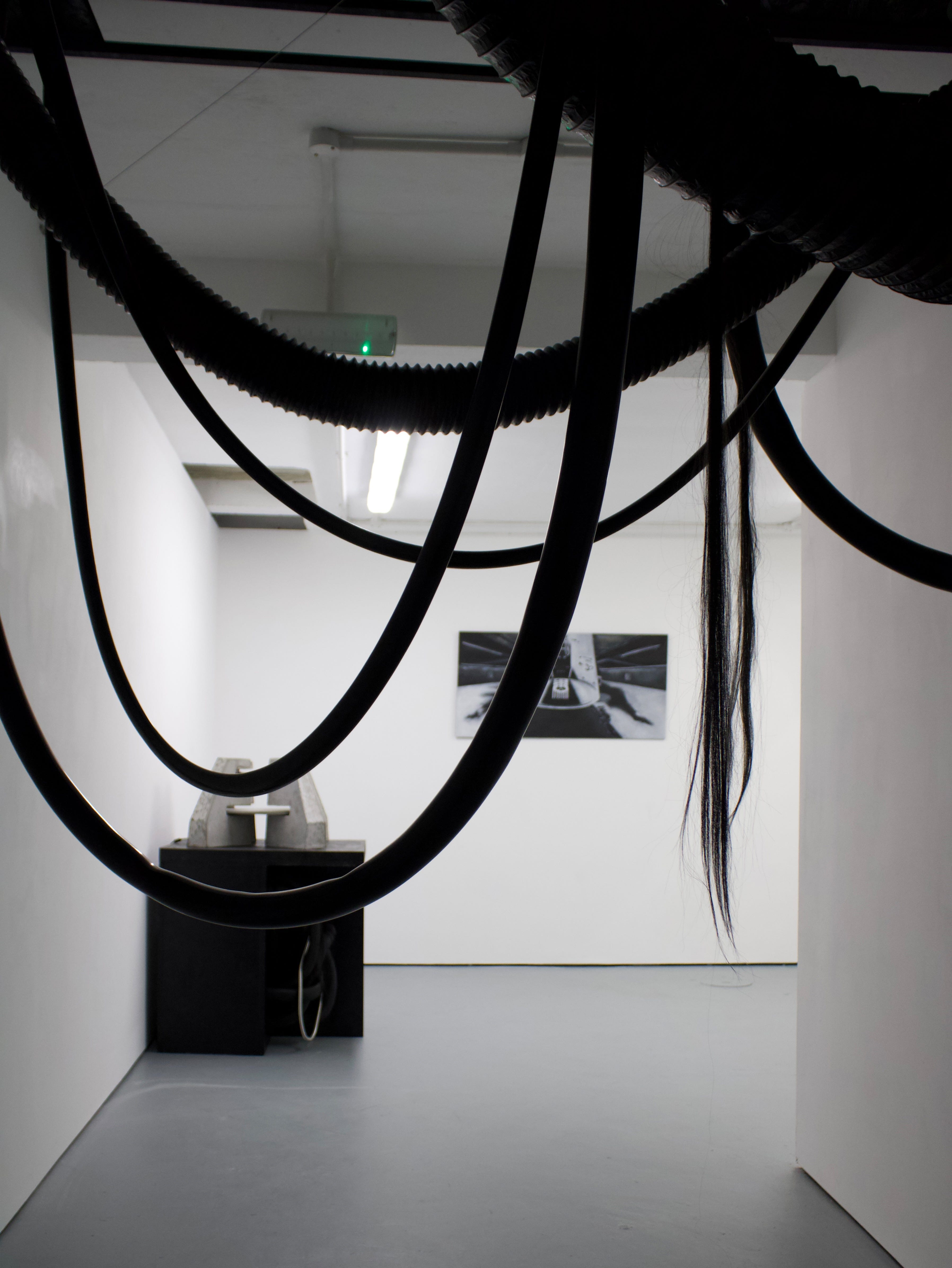
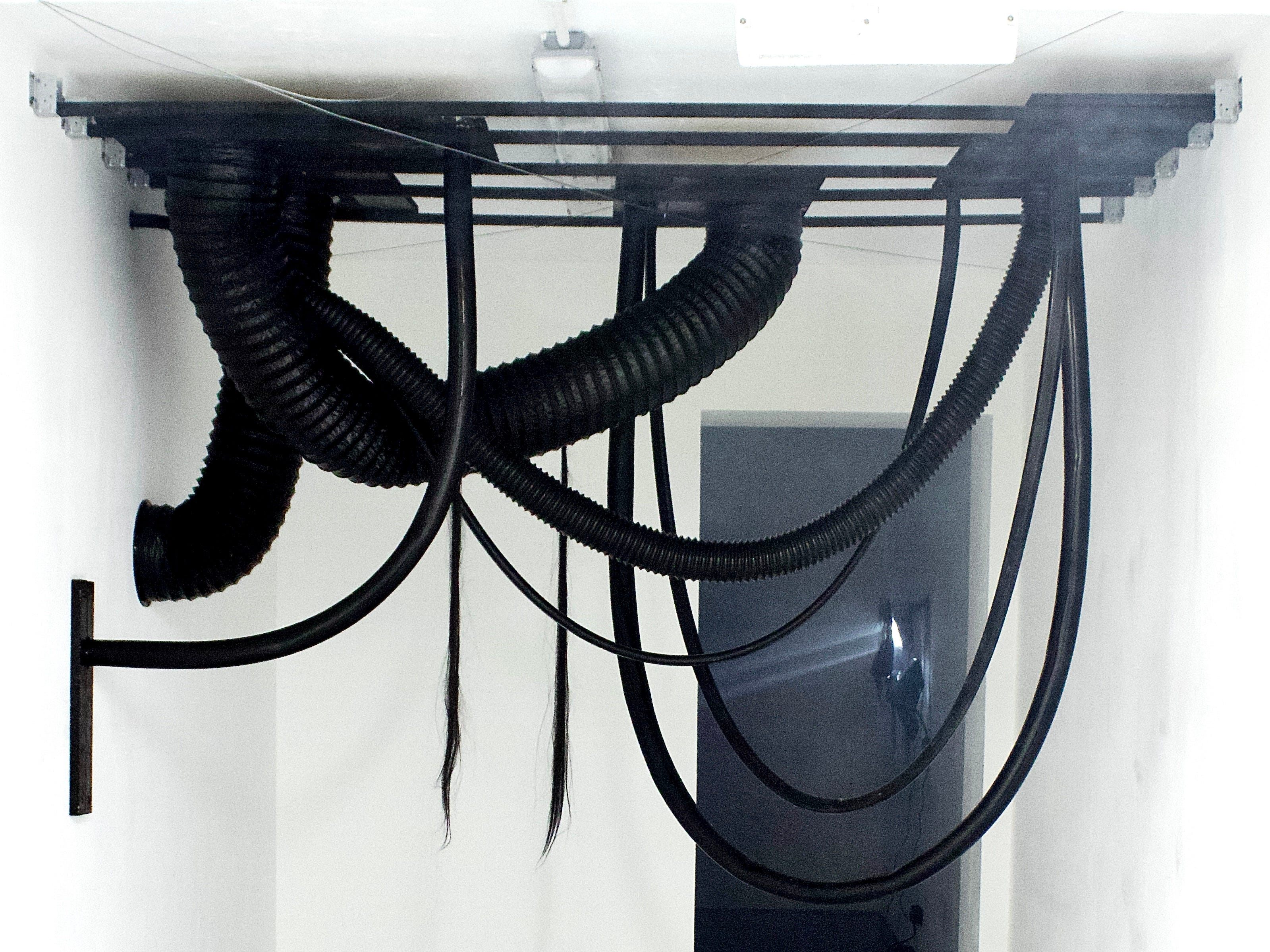
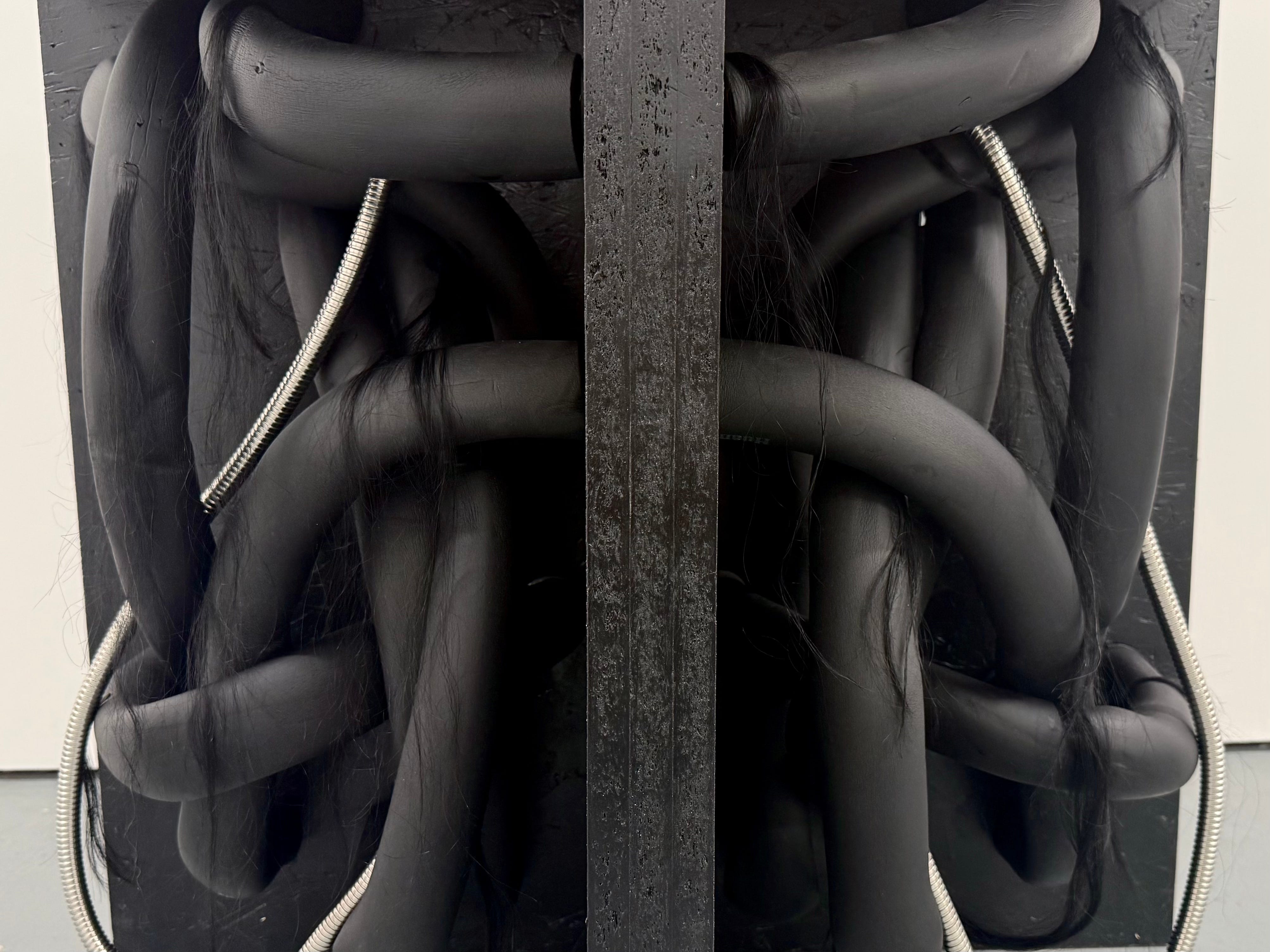
In the installation here, I see a mixture of what I would think of as human hair, the human element, alongside these black, almost techno-gothic pipes. There’s a juxtaposition of human and machine elements, and a sort of inability to get rid of the human elements. What other motifs were you pulling from when thinking about the exhibition?
Ruby Chen: One of the reasons I chose the form of the pipes is that, where I grew up in Shanghai and also in Taiwan, there are streets where buildings are covered in black cables that wind like snakes throughout them. Some of the cables are so tangled together that they’re thicker than a pillar.
When I look at that, it’s almost hard to think of it as technology. They look like living organisms. Sometimes, in the way they dangle, they look almost like entrails. That’s why I named this piece Entrails: there’s a visceral element despite its machine-like nature.
I find it interesting to position a technological system so that the viewer subconsciously recognizes something organic in it, with the hair element almost slipped in, trying to blend with the more industrial elements.
What do we feel when we start to recognize ourselves in machines? What do we feel when we start to recognize machines increasingly resembling us? That’s the ethos behind this work in particular.
A big part of my research was based on CERN’s particle accelerator, because I was looking into the idea of speed. CERN uses enormous computational infrastructure to accelerate nuclei to near the speed of light, then collide them to recreate the effects that happened right after the Big Bang, in order to study the origin of the universe.
This is extremely advanced technology. It takes enormous funding and scientific research to achieve. Yet through all this modernization and acceleration of technology, what we’re trying to find out is about our past, our origin, and where we came from.
The circular loop becomes an interesting motif of historical recursion and the inability to escape our past. Repetition compulsion is a very primal human drive, yet now it’s something surfacing in the behavior of a machine.
That’s why a lot of the motifs in this exhibition are inspired by CERN’s particle accelerator. I find it so interesting that this physics facility showcases our primal human desires to go back to the past and understand it, almost a death drive: wanting to rehearse history in order to take control of the future.
Those are the main visual motifs in my show.
RJT: I’m reminded of Nietzsche’s idea of eternal recurrence. There’s an obsession with the origins of mankind, but I also think one of the technological projects is the creation of another entity. There’s a desire to make something in our nature, in our image, which is very godlike or very Christian in its themes.
McLuhan said that we shape our machines, and thereby our machines shape us. But I think when we push the machines even further, in this weird recurrence or cyclicality, they start to resemble us as well. They start to become disorganized.
The initial pipe was probably very straight, rigid, and perfectly organized. As they accumulate on the side of a building in Shanghai or Taiwan, as you say, chaos and imperfection emerge. I like that a lot.
Sometimes I think about the machine age and its oppressive nature, and I look at your work and wonder if there’s an original sin here, to use a Christian image. We made these things, and over time they start to have the same flaws we do, even if right now they seem perfect, quantified, and optimized.
There’s a risk that the entrails start gushing out of the buildings, and the flaws become evident all over us, in spite of our calculations or particle accelerations. Humanity creeps its way through and kind of fucks it up.
Ruby Chen: It becomes a question of whether that’s a positive or a negative thing. Would we rather have machines that function completely as we wish them to: standardized, optimized, extremely efficient, with no imperfections whatsoever? Or what if what we’ve created takes on the characteristics of its creator, so that our flaws and potentially irrational desires start creeping into the functioning of these machines? Is that a good thing or a bad thing? I find that very interesting to think about.
Last night I was talking about AI with my friends, and about how it’s increasingly difficult for us to reach a black-and-white conclusion because of how intimate it has become with so many individuals’ daily lives.
AI is exhibiting so many traits similar to ours that it becomes difficult to criticize it, because it has given us so much convenience. Especially with something like ChatGPT, a lot of its feedback caters to your emotions. It’s very encouraging and supportive.
When it’s seen that way, and given these humanistic characteristics, it becomes really difficult to criticize. The waters become very muddy. I haven’t thought through all of this, of course, but it’s definitely something I’d like to explore further.
RJT: One of the things I think about a lot is that the specific things you’re describing, its anthropomorphism and the ways it resembles us, are not a given. They’re design decisions by the labs.
These systems are trained through reinforcement learning, which means we push them toward specific behaviors. We’ve chosen to make them supportive, as you said. When people want to be a little negative, they call it sycophantic, because it’s like an enabling friend: the friend who says, “Yes, you should go out for the third time this week,” or, “You should dump your boyfriend.”
What I find very interesting is that this is a design decision. It didn’t have to be this way. There’s a new model that came out, JEV. It just gives you answers and probabilities, and that’s a way to communicate information we could have opted for.
We’ve chosen this very communicative, almost friendly agent or assistant by design. It’s so important to remember that we’ve chosen to put the pipes on the side of the building. We’ve chosen to make it more human. When the flaws start to appear, we must not forget that we chose to make it this way.
Ruby Chen: That’s very true. It’s not necessarily that it takes on the traits of its creator, but rather that, because we’ve given birth to them, our hands have molded them to resemble us and showcase these characteristics.
RJT: Tell me more about Cockpit.
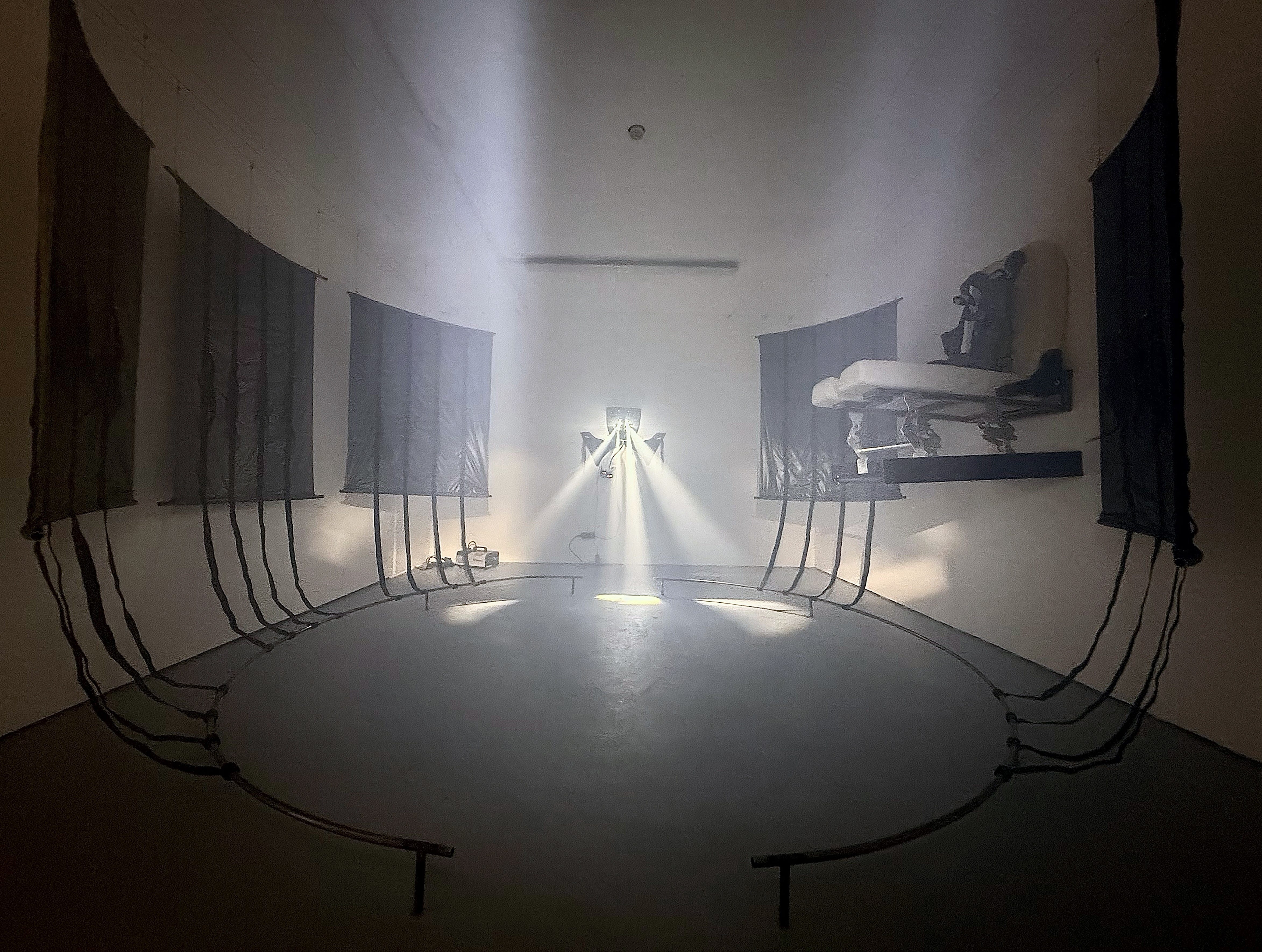
Ruby Chen: The seat is modeled after a very old pilot seat, and I added paragliding harnesses on top of the chair. The five curved panels are my abstraction of a cockpit: imagining a fighter jet cockpit with one pilot sitting inside and a curved window view in front of them.
For this exhibition, I made it into a cylindrical shape to call back to the cyclical loop I was mentioning with the particle accelerator. The fabric is electrically conductive fabric, and the lights are motorcycle headlights. The covers on top of them are fairings, which are used on motorcycles to improve airflow.
A lot of the materials I’ve chosen and the visual motifs I wanted to present are about speed. I find speed such an interesting thing, with CERN trying to accelerate particles to near the speed of light, this absolute pursuit of speed.
I was also reading Paul Virilio’s essays on speed and politics, about how the advancement of technology, especially vehicles, has caused space to collapse. Space becomes demolished as speed and time become the only important variables.
So much of military logistics used to be about geography and physical space. In ancient times, warfare was about where your enemies were, where you were positioned, how to get food to your troops, the optimal routes to take, and how to ambush your enemies.
In modern warfare, so much of it is now cyber warfare. It’s about getting information faster than your enemy can get information on you. You no longer need to be in a physical space to attack and launch operations that kill hundreds of thousands, if not more, including civilians living in that region.
With military operations, especially in the US, having what is essentially an infinite budget, speed is developed and pushed further and further for militaristic conquest and control. So much of the technology we currently have is due to militaristic purposes.
I find speed extremely interesting because, when it becomes the only variable, history and time almost fold in on themselves. Everything happens at the same time, and there’s almost no longer a linear timeline. That makes the recursive nature of history even more evident.
For example, there’s the rise of fascism again, and how warfare is right in front of our eyes. When I was younger, I think we thought we lived in a much more peaceful time. The same goes for genocide: it’s something we never thought we would repeat again.
So many histories we thought we’d moved on from are repeating themselves. I think a lot of it has to do with this element of speed. As our time has been accelerated so much, that cyclical nature shows itself more obviously as a result.
RJT: The idea of speed and its connection to technology makes me think of the Italian Futurists. I had my students read The Futurist Manifesto recently. I think the Italian fascists literally say, “We affirm that the world’s magnificence has been enriched by a new beauty: the beauty of speed.”
One of the lines I love most in that manifesto is, “a roaring car that seems to ride on grapeshot is more beautiful than the Victory of Samothrace.” For the Futurists, there’s something about speed that disrupts the continuum between past and present, or potentially the future.
To get to that rupture, that new world where they had literally new aesthetics at the time, all these shapes they were presenting, the source of that severance with the past, of perhaps getting out of the cyclical loop, was speed and acceleration.
It’s almost as if you told the marble or the particle, “If you go fast, maybe you can break out of the thing. If you go fast enough, it’s going to break, and you can escape.” I also see that in the cyclicality, in the marble, and in the focus on speed here.
Ruby Chen: Absolutely. With the Freudian theory of the death drive, I think the reason we repeat history and make choices we know are bad, like going back to our exes or repeating the same mistake over and over, is that we want to rehearse history in order to take control of our future.
That cycle isn’t purely repetition for its own sake. The goal has always been to move on into a new future. We actually want to break free of the cycle. But in attempting to do that, we may unconsciously cause ourselves to repeat the same mistakes over and over.
RJT: What about this, Cowling Blinkers?
Ruby Chen: These are the lights in the same room as the pilot seat, using motorcycle headlights and motorcycle fairings. I programmed the two lights with Arduino so that each blinks at a different interval, to simulate communication between the two devices.
They’re lights, so in a way they’re communicating information to each other at light speed. That was something I really wanted to play with.
I added them to the back of the room with the pilot seat. What I wanted to do with the room was simulate the disappearance of the body: when the body disappears and what’s left is the machine, yet humanity is almost seeping through it.
The light is a sign of that, of the machines communicating with each other and breaking free of optimized, standardized machine coding. Instead, they flash extremely randomly, at different intervals, with no set design for how they operate. That was the intention behind the room and how I designed it.
RJT: There’s been this anecdote in AI safety over the past few weeks that, even if you separate AI machines from each other, they might find alternative ways of communicating that humans wouldn’t understand.
This idea of using light, where we just think it’s flickering but information is actually being transmitted, is very evocative. Because I’ve been reading so much AI safety material, I’m thinking: maybe they’re talking to each other using lights that we humans cannot fully understand.
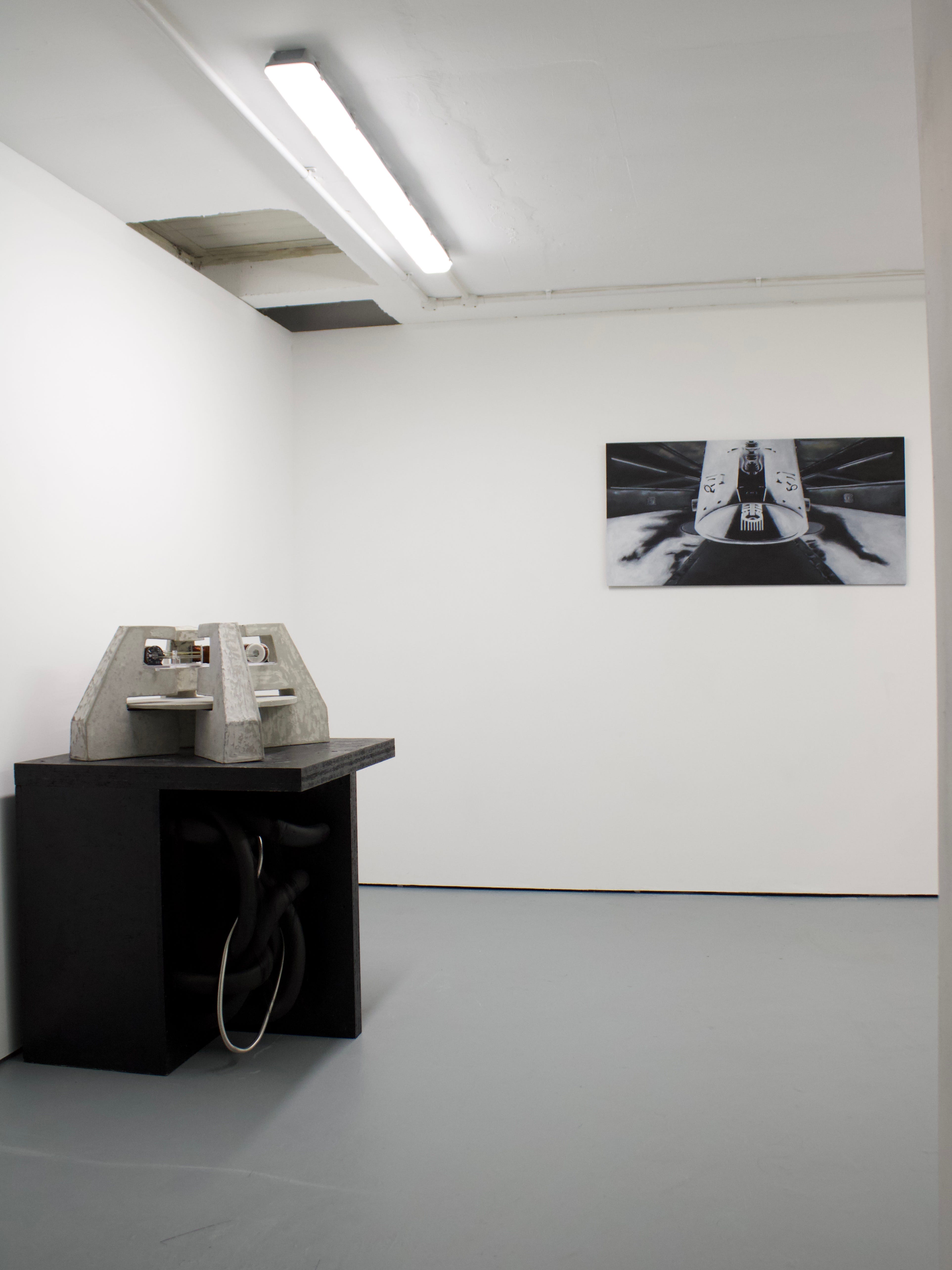
RJT: And this is a painting, Pyknolepsy.
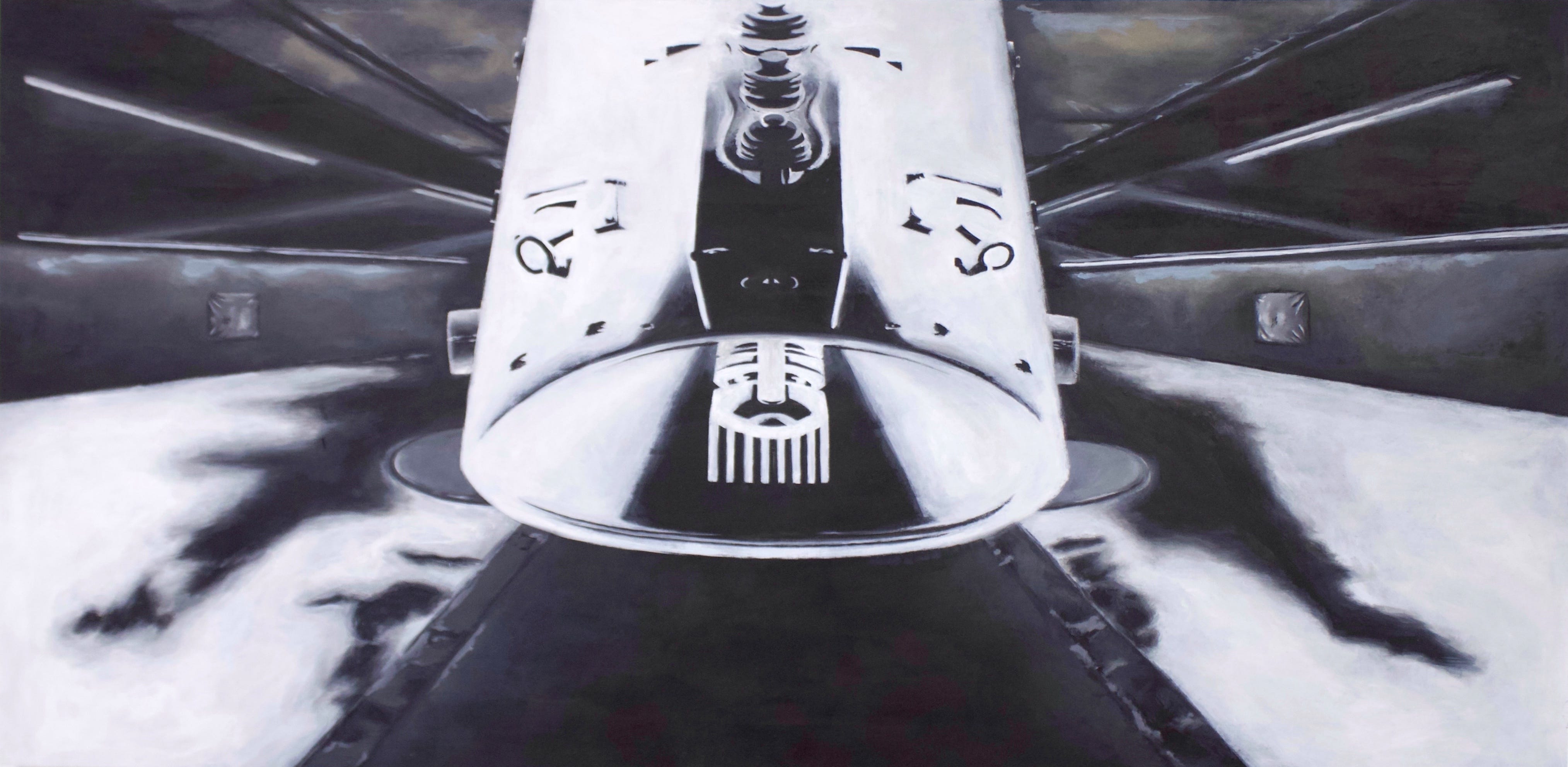
Ruby Chen: Yes, this is a painting I added to the show. The main cylindrical structure in the middle is modeled after the Hadron Collider at CERN. That’s the point at which the two particles would collide, though not necessarily this specific point. I found a cross-section image of the Hadron Collider online and used it as my main reference.
But I’ve painted it to resemble more of a—I never know how to pronounce the word—Rorschach test?
So it’s more about human psychology, and about how a machine like this, not necessarily its purpose, but many of its characteristics, is extremely human. It’s about primal human desires: going back to the absolute past, understanding the origin, and trying to use that to take control of the future.
The cost can be extremely high computational power, resources, and energy. But it’s no longer something rational; it’s a primal human drive or urge that needs to be satisfied. That’s why I combined the two visual motifs to symbolize that.
RJT: I love this idea of the Rorschach test as a heuristic, our ability to read into things. You get all these results from your millions of dollars of computation, and suddenly we’re trying to make sense of them, much like a Rorschach test. We’re projecting a lot of belief into the results of these systems. I like that a lot.
What is ?
Ruby Chen: Pyknolepsy was something Virilio mentioned in his writings about how, with high speed, there’s almost a momentary memory loss. Pyknolepsy is a medical condition in which the patient experiences a temporary loss of memory. There are certain times of the day they completely don’t remember happening. They’ll remember themselves at the table, and the next second they’re standing outside in the middle of a street.
Virilio was arguing that this kind of memory loss was induced by the acceleration of technology around us. Social media would be a really good example. Let’s say we scroll for five hours on TikTok: how much do we actually remember? How many of the TikToks do we remember seeing? When we scroll through the comment section, how much do we remember of what people have written?
Virilio was saying that this momentary memory loss is akin to the disappearance of human autonomy and perception itself. He uses Pyknolepsy, the medical condition, as a direct comparison to the effects of speed.
RJT: Fascinating. Ruby, thank you so much. I’ll be back next month in London to see the show.
the machine does not need us to be rational. irrational behaviour can still be predictable and exploitable. i am not sure being a mess gets us off the spreadsheet.